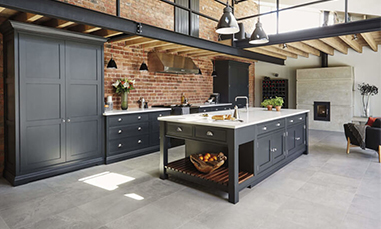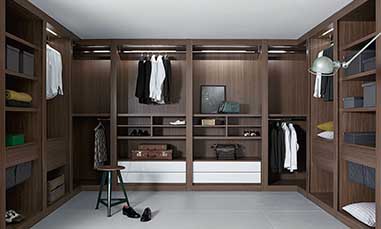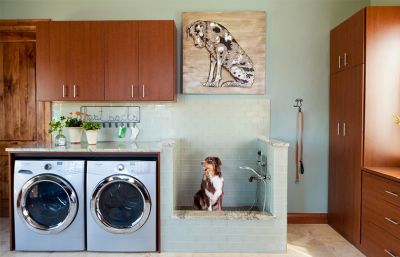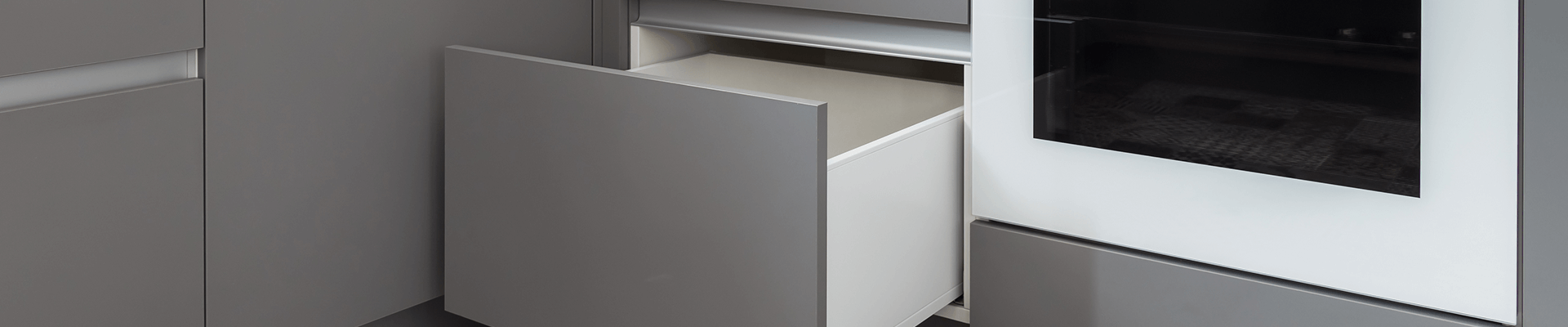



Stock when the room is standard and the date is fixed. Semi-custom when the box is standard but the fronts and a few dimensions are not. Custom when the wall is not standard, the drawings are yours, or the project has 40 identical units that must fit to the millimetre.
The real difference is not price, it is who absorbs the dimensional error. Stock pushes it to filler panels; custom absorbs it in the carcass.
Stock is 3–7 days and a catalogue. Semi-custom is 4–8 weeks. Custom from a factory is 45–75 days including sea freight.
Every model can hit a budget — they fail in different places. Stock fails at the wall; custom fails at the approval stage.
Custom does not mean unique. It means built to a drawing, which for a 40-unit apartment job is the only way to get 40 identical cabinets.
Semi-custom is the worst of both when the wall is out by more than 20 mm: you pay custom prices for a box that still needs fillers.
1. The three models, precisely
Stock cabinets come in fixed widths from a catalogue — typically 300, 400, 500, 600, 800, 900 mm — with a fixed depth and height. The gaps at the ends of a run are closed with filler panels, which is why stock kitchens so often have a 60 mm strip beside the wall.
Semi-custom keeps a standard carcass and varies the front: door style, finish, and sometimes width in 50 mm steps. It is a catalogue with options, not a drawing.
Custom means the factory builds to your drawing: any width to the millimetre, any height, any internal layout, and the carcass is cut after the site dimensions are confirmed.
| Property | Stock | Semi-custom | Custom |
|---|---|---|---|
| Widths | Fixed catalogue | 50 mm steps | To the millimetre |
| Height to ceiling | Rarely | Limited | Yes, with a scribe |
| Internal layout | Fixed | Limited options | Any |
| Lead time | 3–7 days | 4–8 weeks | 45–75 days door to door |
| Minimum order | One unit | Usually a kitchen | One container or one project |
| Who absorbs wall error | Filler panel | Filler panel | The carcass |
2. Lead time, and what it does to the programme
Stock is not really 3–7 days for a kitchen. That is the cabinet; the benchtop templating, the appliance delivery and the trade sequence still take weeks. What stock buys you is the ability to start late.
Custom buys the opposite: you must freeze drawings early, because production runs 30–45 days and the sea freight adds 18–25. Plan 16 weeks from drawing freeze to handover, and accept that a change after approval is scrap.
3. Cost, including the parts nobody quotes
Stock looks cheapest per cabinet and often is not cheapest per kitchen, because fillers, panels and the labour to scribe them are priced separately or absorbed by the installer.
Custom looks expensive per cabinet and can be cheaper per project when 40 identical units let the factory set up once. The saving is in repetition, not in the unit price.
| Cost line | Stock | Custom |
|---|---|---|
| Cabinet unit price | Lowest | Highest |
| Fillers and scribes | Often extra | Built in |
| Installation time | Longer | Shorter |
| Change after order | Swap a unit | Scrap |
| Best value when | One room, standard walls | Many identical units |
4. Where each model breaks
Stock breaks at the wall. A 2,480 mm run with stock widths leaves a filler, and a filler beside a window reveal is visible for the life of the kitchen.
Semi-custom breaks in the middle. It is priced like custom and constrained like stock, so a wall that is 30 mm out still ends in a filler — and the client has paid a premium for nothing.
Custom breaks at approval. Once the shop drawings are signed, the panels are cut. Every late change is material plus a production slot, and on a 200-unit job one late change costs more than the drawings.
5. Choosing by project type
A single kitchen renovation in a house with straight walls: stock or semi-custom. The premium for custom buys nothing you can see.
An apartment project with 40 identical units: custom, without question. The repetition pays for the drawings, and identical units install faster.
A heritage flat with 3 m ceilings and walls that are 25 mm out: custom tall units with a scribe, or accept a visible filler. Do not buy semi-custom and hope.
Frequently asked questions
Is custom always more expensive?
Per cabinet, yes. Per project, not necessarily — 40 identical units let the factory amortise setup, and installation is faster.
How long does a custom kitchen take?
40–75 days depending on complexity, plus 18–25 days sea freight for export. Plan 16 weeks from drawing freeze.
Can semi-custom handle an out-of-square wall?
Up to about 20 mm with a filler. Beyond that you are paying custom prices for a stock constraint.
What is the minimum order for custom?
Usually a full project or a container. Below that, the setup cost per unit makes it uncompetitive against stock.
Do stock cabinets look cheaper?
They can, because the reveals at the wall give it away. With a careful layout and integrated appliances, stock reads fine — the filler is the tell.