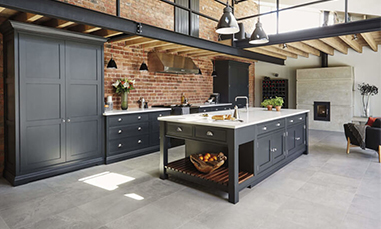
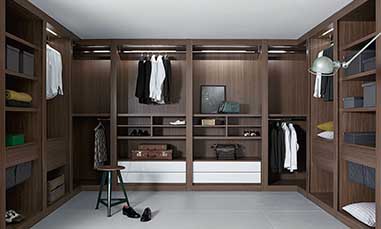
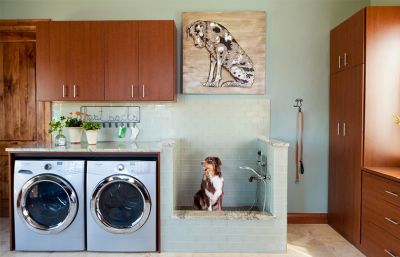
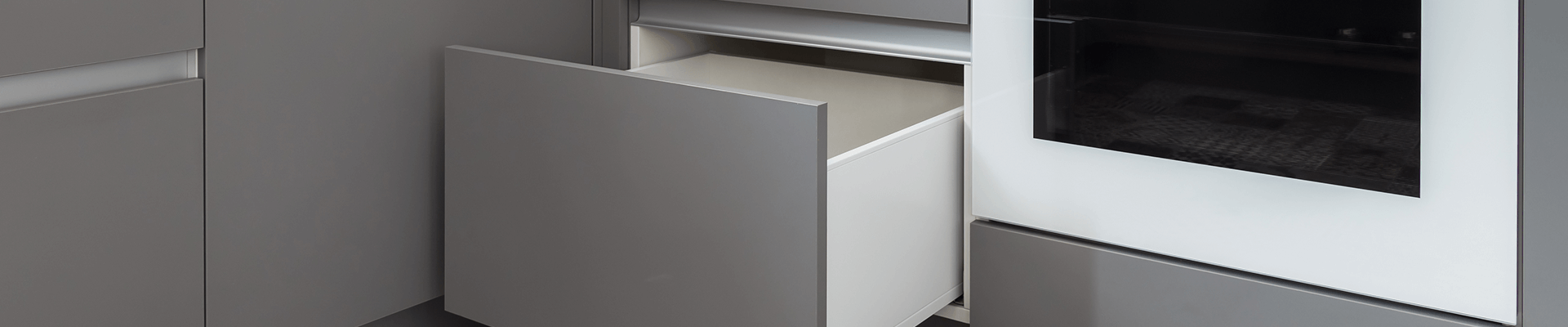
Thermofoil for profiled doors at low cost — shaker recesses, beaded edges, curved rails — anywhere away from direct heat. Painted MDF where the door will see heat, where a colour has to match joinery, or where the budget allows a film that can be touched in.
Thermofoil is a PVC film vacuum-formed over an MDF door. The film wraps face, edges and recess in one piece, so there is no joint to lift.
That also means no edge banding and no visible seam — the reason it dominates low-cost shaker doors.
The weakness is heat: PVC softens at roughly 70–80 °C. Above an oven, beside a hob, or where a dishwasher vents into the run, the film can lift and blister.
Painted MDF handles heat and can be repaired, but the edge is the tell: a painted edge needs a sealed, sanded, primed substrate or it shows a line within a season.
Cost: thermofoil is typically 20–35% cheaper on a profiled door, because there is no spray, no sanding between coats and no drying time.
1. Two processes, one substrate
Both start with MDF, machined to the profile. Thermofoil then heats a PVC film and draws it over the door under vacuum, so the film follows every curve and wraps the back edge.
Painted MDF is sealed, primed, sprayed and sanded — usually two build coats and a top coat, with the edge getting extra attention because MDF edge fibre absorbs differently from the face.
| Step | Thermofoil | Painted MDF |
|---|---|---|
| Substrate | MDF, machined | MDF, machined |
| Surface | PVC film, vacuum formed | Sealer, primer, 2–3 coats |
| Edge | Wrapped in the same film | Sealed, sanded, painted |
| Cure | Cooling | Chemical or air dry |
| Repair | Not possible | Touch-in or re-spray |
2. Profiles: where thermofoil wins outright
A shaker recess has four internal corners. In painted MDF those corners are machined and painted, and the paint pulls thin exactly where a hand goes. In thermofoil the film is one continuous surface, including the corners.
The same applies to a beaded edge, a curved top rail or a routed finger pull. The tooling is the mould, not a set of cutters, so complex profiles cost almost the same as flat ones.
3. Heat, and the one place it always fails
PVC softens at roughly 70–80 °C. A door directly above a built-in oven, or beside a hob where a pan is set down against the cabinet, can reach that. When the film lifts it does not go back — the door is replaced, and a replacement will not match a three-year-old run exactly.
This is a placement problem, not a product problem. Bedroom wardrobes, bathroom vanities, studies and low-use kitchens are all fine. The cabinet above the oven is not, in any brand.
| Location | Thermofoil | Painted MDF |
|---|---|---|
| Bedroom wardrobe | Good | Good, higher cost |
| Bathroom vanity | Good, if vented | Good |
| Kitchen away from heat | Good | Good |
| Directly above an oven | Do not use | Good |
| Beside a hob | Risky | Good |
| Laundry, high humidity | Good | Good with sealed edges |
4. Repair and colour matching
A thermofoil door cannot be repaired. A lifted corner, a cut or a scorch mark means a new door, and the new film may not match a batch three years old.
Painted MDF can be touched in with the same batch, provided the sheen matches. On a large door or a run of full-height fronts, that difference is worth more than the 20–35% saving — because the alternative is replacing a door that no longer matches its neighbours.
5. Choosing between them
Budget-driven project with shaker profiles and no heat exposure: thermofoil. It is the only way to get a seamless recess at that price.
High-end kitchen with a specific colour, or any door within a metre of a heat source: painted MDF, and specify the edge build — sealer, primer, two top coats, sanded between.
A mixed approach works too: thermofoil in the bedroom and laundry, painted in the kitchen. Same colour reference, different process, and the door that sees heat is the one that can take it.
Frequently asked questions
Is thermofoil the same as vinyl wrap?
Yes. Thermofoil, PVC film, membrane press and vinyl wrap all describe a PVC sheet vacuum-formed over an MDF substrate.
Why is the film lifting on my doors?
Heat or moisture reaching the adhesive layer. Once lifted it cannot be re-bonded invisibly — the door is replaced.
Can painted MDF doors be used above an oven?
Yes, and they should be. A 2K PU or similar film handles the temperature that softens PVC.
Is thermofoil cheaper than painted?
Typically 20–35% cheaper on a profiled door. On a flat door the gap narrows, because both processes are simpler.
Do painted MDF doors show the edge?
They can, if the edge is not sealed and primed properly. MDF edge fibre absorbs paint differently from the face, and the line appears within a season.