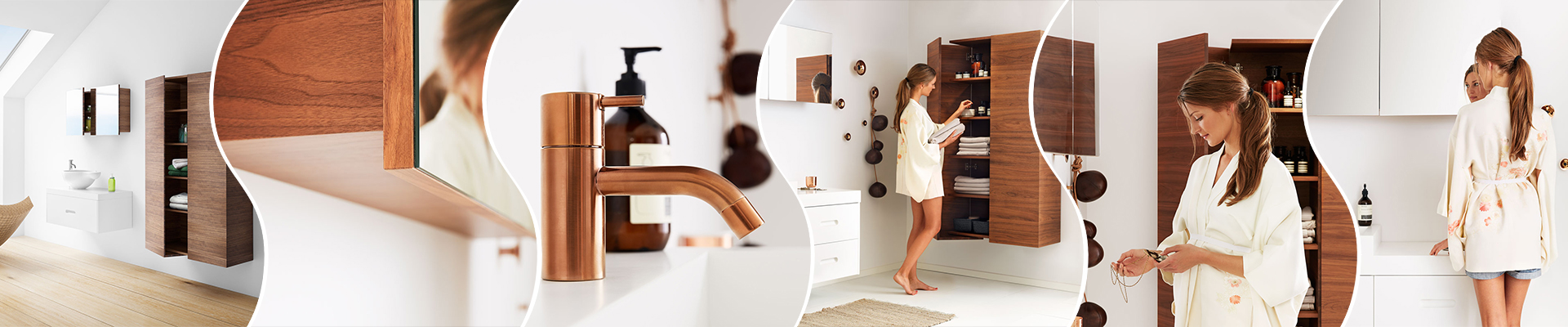



Solid wood costs 2–4x a veneered door and can be sanded back, but it moves 6–10% with seasonal humidity and is the less stable choice on wide doors. Veneer on an MDF core is more stable, gives more consistent grain and handles wide fronts better. Use solid wood where the edge must read as timber and the door is narrow; use veneer for wide doors, consistent grain and painted finishes.
Solid wood doors cost 2–4x a veneered equivalent.
Solid wood moves with humidity; a 600 mm door can move several millimetres seasonally.
Veneer on MDF is more stable on wide doors and gives controlled grain.
Solid wood can be sanded and refinished; veneer needs careful patching.
For painted wide doors, an MDF core is usually the more reliable substrate.
1. What each door actually is
A solid wood door is timber through its thickness, usually staved or finger-jointed to control movement. A veneered door is a thin face, typically 3–5 mm, bonded to an MDF or particleboard core. The core does most of the stability work; the veneer supplies the look.
That difference explains most of the cost and nearly all of the behaviour. Solid wood is a piece of the tree; veneer is a controlled surface on a stable core. The core itself is covered in our carcass materials guide.
2. Cost and stability compared
| Property | Solid wood | Veneer on MDF |
|---|---|---|
| Relative cost | 2–4x | Baseline |
| Movement | 6–10% seasonal | Low |
| Wide door stability | Poor above 600 mm | Good |
| Grain consistency | Random | Book-matched |
| Repair | Sandable | Patch only |
Stability is the line that decides most projects. A wide solid door that moves 3 mm will show a paint line or a sticking edge within a season. A veneered door on MDF does not move the same way, because the core is dimensionally stable.
3. Where solid wood wins
Solid wood wins where the edge is seen: a shaker frame, a raised panel, a rounded profile or a piece of freestanding furniture. It also wins on repair, because a scratch can be sanded out and refinished. For narrow doors, framed doors and heritage work, that is often worth the premium. The door styles guide shows which profiles naturally use a solid frame.
4. Where veneer wins
Veneer wins on wide doors, consistent grain and painted finishes. A book-matched veneer can look more controlled than solid wood, because the grain is selected rather than random. On a run of full-height doors, the visual consistency matters more than the edge. For colour consistency across batches, see our colour matching guide.
5. Finishing and repair
Both doors take paint, lacquer and stain, but the substrate changes the result. Solid wood shows joint lines and movement under paint; MDF cores stay flat. On repair, solid wood can be sanded and refinished, while veneer needs a patch that matches grain and colour. Our door finishes guide covers the finish systems and their wear characteristics, and the edge banding guide covers what happens at the door edge.
6. Specifying the door
Specify by performance: door width, substrate, veneer thickness, finish system and tolerance for movement. Above 600 mm, require a stable core unless the design explicitly calls for solid timber. State the veneer lay-up if grain consistency matters. And ask for a sample door, not a sample chip, because the edge and the finish are where the difference shows. Hinge choice follows door weight, which the hardware specification guide sets out.
7. Cost per door, not per square metre
Compare doors by cost per door at the actual width, not by square metre. A wide veneered door uses more core and more veneer, but it does not need the staving and jointing a solid door needs, so the gap widens as the door gets wider. On a run of 600 mm doors the solid premium can reach 3–4x; on 400 mm frames it can fall to 2x. Price the actual schedule, and check the landed cost carries the door as a separate line.
Frequently asked questions
Is solid wood better than veneer?
Not automatically. Solid wood is repairable and reads as timber through the edge, but it moves with humidity and costs 2–4x. Veneer is more stable on wide doors and gives more consistent grain.
Why does solid wood move?
Wood absorbs and releases moisture across the grain. A 600 mm wide solid door can move several millimetres seasonally, which stresses joints and paint.
Can veneer doors be repaired?
Small chips can be patched with colour-matched wax or a veneer patch. Deep damage on the face is harder to hide than on solid wood, which can be sanded.
Does veneer look cheaper?
Not if the veneer and lay-up are good. A book-matched veneer door can look more consistent than solid wood, because the grain is controlled rather than random.
Which is better for painted doors?
MDF with a veneer or painted face is usually more stable for wide painted doors. Solid wood painted doors can show joint lines as they move.
What thickness should a veneer door be?
Most cabinet doors are 18–25 mm, with a 3–5 mm veneer face on an MDF or particleboard core. The core does most of the stability work.