HMR is moisture-resistant particleboard, usually with a green core. It is required in sink runs, laundries and bathrooms, and it must be sealed at the cut edges. Standard board swells once water reaches the core; HMR slows that process, but it is not waterproof. The cut edge is where the board fails first.
HMR is moisture-resistant, not waterproof.
Use it in sink runs, laundries and bathrooms.
Seal every cut edge.
Verify with the board invoice, not just the colour.
Compact laminate or solid surface for fully wet areas.
1. What HMR is
HMR stands for high moisture resistance. It is particleboard made with a moisture-resistant resin, often dyed green so it can be identified. It absorbs water more slowly than standard board, which buys time when a leak or a spill happens. It does not make the board waterproof.
2. Where it is required
| Area | Board | Note |
|---|---|---|
| Sink run | HMR | Seal cut-outs for sink and tap |
| Dishwasher housing | HMR | Steam and leaks |
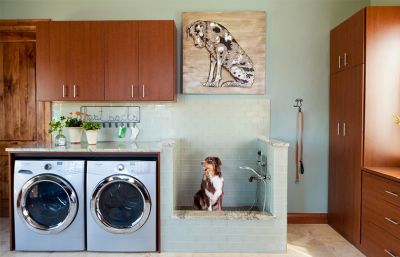
| Laundry | HMR | Machine and tub |
| Bathroom vanity | HMR | Basin and waste |
| Dry cabinets | Standard | HMR not required |
The areas that matter are the ones with a water connection or a steam source. A dry pantry does not need HMR; a sink run does.
3. The cut edge
Board is protected on the face but exposed at the cut. A sink cut-out, a tap hole or a raw edge at the wall is where water enters. Seal every cut edge with edge banding, sealant or a waterproof membrane. The face is rarely the failure; the edge is.
4. Verification
Ask for the board invoice or certificate and check the core colour. A green core is a common marker, but the invoice is the stronger evidence. A factory that cannot produce either is asking you to trust a colour.
5. Alternatives
Compact laminate and solid surface do not have a swelling core, so they suit fully wet areas better than HMR. They cost more and need different fixings. For a family bathroom, HMR with sealed edges is usually enough; for a commercial shower block, it is not.
6. Sealing and membranes
Seal cut edges and use a waterproof membrane behind tiles and around wet zones. The cabinet is the last line of defence, not the first. A membrane that fails will defeat the best board.
7. Specifying HMR
Name the board, the areas and the sealing requirement. A specification that says moisture-resistant without naming the areas leaves the choice to the factory. The carcass materials guide covers the board options.
8. Common mistakes
Three mistakes recur: using standard board under a sink, sealing the face but not the cut edge, and assuming HMR is waterproof. Each is cheap to avoid at specification stage and expensive to fix after a leak.
9. A checklist before you commit
Before you sign, confirm six things: the board grade, the hardware model, the finish system, the packing standard, the inspection scope and the payment schedule. Each should be in writing, not in a call. The quote checklist turns the six into a one-page comparison.
10. Common mistakes
The most common mistake is comparing a factory price with a landed cost. The second is leaving the inspection out of the budget. The third is paying the balance before the inspection is signed off. Each is avoidable with a written scope and a pre-shipment inspection.
11. How to measure the room
Measure each wall at three points, top, middle and bottom, and use the smallest. Walls are rarely square, and a 10 mm bow over three metres changes the filler. Measure the ceiling at each corner and note sockets, radiators and soil pipes before drawing. A measured survey saves more time than a faster drawing, and the measuring guide has a printable sheet.
13. A specification checklist
Write four lines for every material: the product, the grade, the thickness and the surface or edge treatment. A material specified by name alone leaves the grade to the factory, and the grade is where the cost and the performance sit.
14. Questions the factory will ask
Expect four questions: which grade, which thickness, which edge and which batch. The answers should already be in the specification. If they are not, the factory will choose, and the choice will be the cheapest that meets the drawing.
Frequently asked questions
What is HMR board?
HMR is moisture-resistant particleboard, usually with a green core. It uses a moisture-resistant resin that slows water absorption, but it is not waterproof.
Where is HMR required?
Sink runs, dishwashers, laundries and bathrooms. Any cabinet that can get wet should use HMR, with sealed cut edges.
Is HMR waterproof?
No. It resists moisture far better than standard board, but prolonged water still causes swelling. Seal the edges and fix leaks.
How do I verify HMR?
Ask for the board invoice or certificate, and check the core colour. A green core is a common marker, though the invoice is the stronger evidence.
Can I use HMR everywhere?
You can, but it costs more and is not necessary in dry areas. Use it where water is likely, and standard board elsewhere.
What is better than HMR?
Compact laminate or solid surface for a fully wet area. They cost more but do not swell at the core.