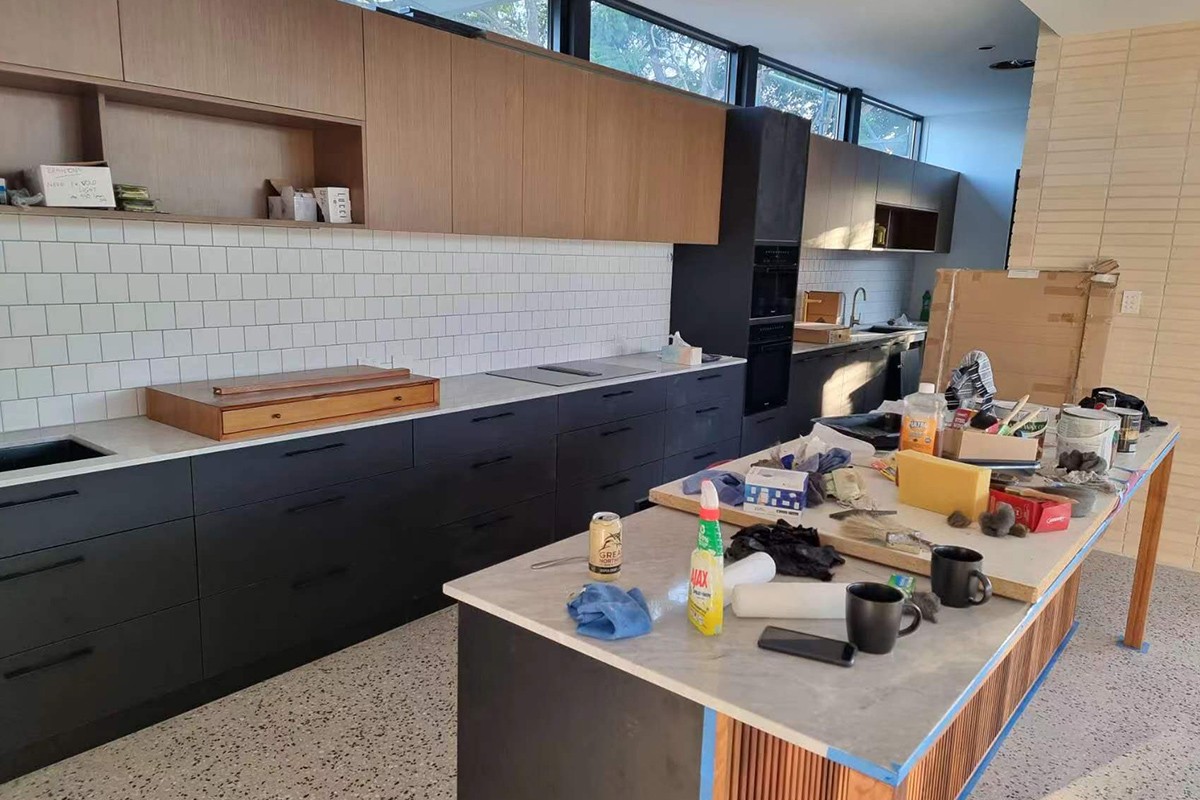



The carcass — also called the cabinet box or case — is the structural body of a cabinet: two side panels, a bottom, a top or top rails, a back panel and the shelves. Doors, drawer fronts and the benchtop are fixed to it, but they are not part of it. Board grade, board thickness, joint method and back panel fixing are all decided at the carcass.
What the carcass includes
A standard base or wall unit is built from six parts before any door is fitted:
Two side panels (gables). The load-bearing parts. In a base unit they carry the benchtop and everything on it.
Bottom panel. Sits between the gables, usually rebated or dowelled.
Top. Either a full panel or two rails (front and back). Rails save material and leave room for services; a full panel is stiffer.
Back panel. 3–6 mm HDF or MDF in most export product, sometimes 18 mm where the back is visible.
Shelves. Adjustable on pins, or fixed and dowelled for higher loads.
Fittings. Hinge plates, drawer runners, shelf pins, adjustable feet.
Two details are commonly confused with the carcass but are not part of it: the face frame on framed cabinets, and the end panel added on site to close a run against a wall.
Board thickness: 16 mm versus 18 mm
Both are standard. The difference is not cosmetic — it changes stiffness over a span, how much material a screw or cam fitting has to bite into, and the weight you are shipping.
| Property | 16 mm | 18 mm |
|---|---|---|
| Panel weight per m² | Baseline | About 12% heavier |
| Stiffness over a span | Adequate to roughly 900 mm | Noticeably stiffer on long shelves and wide drawers |
| Fixing depth for hinges and cams | Shallower; requires correct screw length | More material to bite into |
| Internal volume | Slightly larger for the same external size | Slightly smaller |
| Typical use | Flat-pack and RTA ranges, budget projects | Custom and project specification, large spans, stone tops |
| Freight impact | Lower weight per container | Fewer units per container at the same volume |
For apartment work with 600 mm base units and stone benchtops, 18 mm is the safer default: the extra stiffness shows up as fewer callbacks for sagging shelves and loosened hinges. For RTA ranges shipped flat, 16 mm keeps weight and freight down and is normal for the category.
How the box is joined
Three methods cover almost all export cabinetry, and the choice decides whether the unit ships flat or assembled:
| Method | How it works | Strength | Can it be taken apart? |
|---|---|---|---|
| Cam and dowel | Dowel locates, cam locks | Good | Yes — the basis of flat-pack |
| Confirmat screw | Coarse screw straight into the panel edge | Very good | Yes, with visible holes |
| Dowel and glue | Glued dowels, clamped in the factory | Best | No |
Dovetail joints belong to drawer boxes, not to the carcass. If a supplier describes a dovetail carcass, they usually mean the drawer boxes.
The back panel and racking
The back panel is the cheapest part of the cabinet and the one that decides whether the box stays square. A 3 mm back stapled flat to the rear adds little; a 5–6 mm back set into a groove, or a back fixed with a continuous bead of adhesive, resists racking far better. On tall units and wide drawer banks this is what stops the box from going out of square during transit and installation.
Wall units and tall units still need mechanical fixing to the wall. The back panel is not a structural anchor, whatever its thickness.
Frequently asked questions
Is the carcass included when I buy cabinet boxes?
Yes — a "cabinet box" is the carcass. Doors, drawer fronts, handles, benchtop and kickboards are normally quoted separately unless the supplier specifies a complete unit.
Does 16 mm versus 18 mm really matter in a kitchen?
On short spans and light loads, rarely. It matters on shelves wider than about 900 mm, on wide drawer banks, under stone benchtops, and anywhere the cabinet will be moved or re-used. The cost difference is small relative to the risk of sagging.
Can a glued carcass be dismantled for shipping?
No. If the project needs flat-pack freight, the carcass must be cam-and-dowel or confirmat. Decide this before the sample is approved — it changes packing, volume per container and site labour.
What board should the carcass use in laundry and bathroom areas?
Moisture-resistant board (HMR) for the carcass and shelves, with sealed edges. Standard particleboard with a green-dyed edge is a convention, not a guarantee — ask for the board specification, not the colour.