


18 mm for kitchen base units, anything under a stone benchtop, wide drawer banks and shelves over 900 mm. 16 mm for RTA ranges, wardrobe carcasses and compact units where spans are short and freight weight matters. The difference is stiffness, not strength.
18 mm board is about 12% heavier per square metre. On a container of carcasses that is a real freight number, not a rounding error.
Stiffness rises faster than thickness. A 16 mm shelf is adequate to about 900 mm; beyond that, sag becomes visible and permanent.
Hinge and cam fittings need material to bite into. 16 mm leaves less margin, and the correct screw length matters more.
The 32 mm system hole pitch is the same on both boards, so hardware and shelf pins are interchangeable.
Under a stone benchtop, specify 18 mm regardless of span — the load is concentrated, not distributed.
1. What two millimetres changes
Not strength in the everyday sense. Both boards hold a cabinet together. What changes is stiffness over a span, the depth available for a screw or cam, and the weight you move from factory to site.
Weight is the one people underestimate. An 18 mm panel is roughly 12% heavier than a 16 mm panel of the same area, and a kitchen has a lot of area. That difference shows up in freight, in handling on site, and in what a single installer can lift alone.
| Property | 16 mm | 18 mm |
|---|---|---|
| Weight per m² | Baseline | About 12% higher |
| Stiffness over a span | Adequate to ≈900 mm | Noticeably stiffer |
| Fixing depth | Shallower | More material for screws |
| Internal volume | Slightly larger | Slightly smaller |
| Freight | Fewer kg per container | More kg per container |
| Typical use | RTA, wardrobes, compact units | Kitchens, stone tops, wide drawers |
2. Span, sag and the 900 mm line
A shelf does not fail suddenly. It deflects, slowly, and the deflection becomes permanent because the board takes a set. At 16 mm and 900 mm span, a typical kitchen load stays inside what most people would call flat. At 1100 mm it does not.
This is why 18 mm is specified on wide drawer banks even though the drawer box carries the load — the front rail spans the opening, and a 16 mm rail on a 900 mm opening bows visibly under a full pan drawer.
3. Hardware and fixing depth
A 35 mm hinge cup bored into a 16 mm door leaves 3–5 mm of material behind the cup. That is enough, but only with the correct screw length; a screw 2 mm too long shows on the face as a blister, and it cannot be fixed.
Cam fittings have the same issue from the other side. The cam housing needs a 15 mm deep hole, which is comfortable in 18 mm and tight in 16 mm. On 16 mm board, specify the shorter housing rather than letting the line decide.
4. Freight: where 16 mm actually pays
On a flat-packed container, panel weight is a large share of the total. Dropping to 16 mm across carcass panels can cut several hundred kilograms, which matters when you are near a weight limit rather than a volume limit — common on high-cube containers loaded with dense board.
It does not pay on a small order or a short route, where the freight difference is a few dollars a unit and the specification risk is a callback six months later.
5. Specifying by application
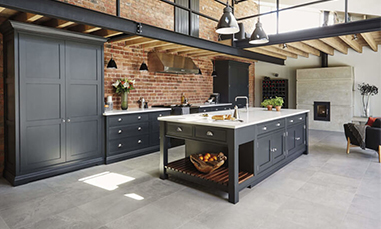
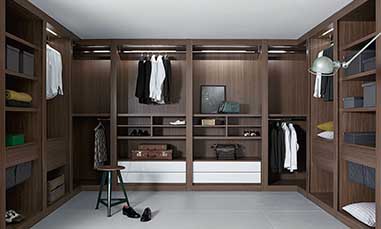
Kitchen base and wall units: 18 mm. Stone benchtops: 18 mm, no exception. Wide drawer banks over 800 mm: 18 mm, plus a mid rail above 900 mm. Wardrobe carcasses: 16 mm is fine, because the spans are short and the loads are clothes.
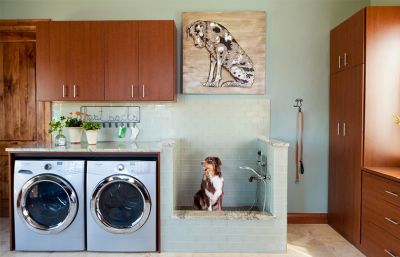
Wet areas: 18 mm HMR or MR MDF, with sealed edges. The extra thickness buys margin where the board is most likely to be abused, and the cost difference on a vanity is trivial against replacing one.
| Application | Thickness | Note |
|---|---|---|
| Kitchen base and wall units | 18 mm | Stone top load, wide drawers |
| Wardrobe carcass | 16 mm | Short spans, light loads |
| Laundry and vanity | 18 mm HMR | Sealed edges matter more |
| Drawer bank over 800 mm | 18 mm plus mid rail | Front rail spans the opening |
| RTA flat-pack range | 16 mm | Freight weight |
Frequently asked questions
Is 16 mm board strong enough for kitchen cabinets?
For wall units and narrow base units, yes. For wide drawers, stone benchtops and shelves over 900 mm, 18 mm is the safer specification.
How much heavier is 18 mm board?
About 12% per square metre at the same density. Across a full kitchen that is a few hundred kilograms.
Does 2 mm matter for hinges?
It matters for screw length. A cup bored into 16 mm leaves 3–5 mm behind it, so the wrong screw shows on the door face.
Can I mix 16 mm and 18 mm in one kitchen?
Physically yes, but the external dimensions change and the runs will not align. Decide per project, not per cabinet.
Which thickness for a laundry or vanity?
18 mm, moisture-resistant, with sealed edges. The cost difference per unit is small against the risk of a swollen panel.