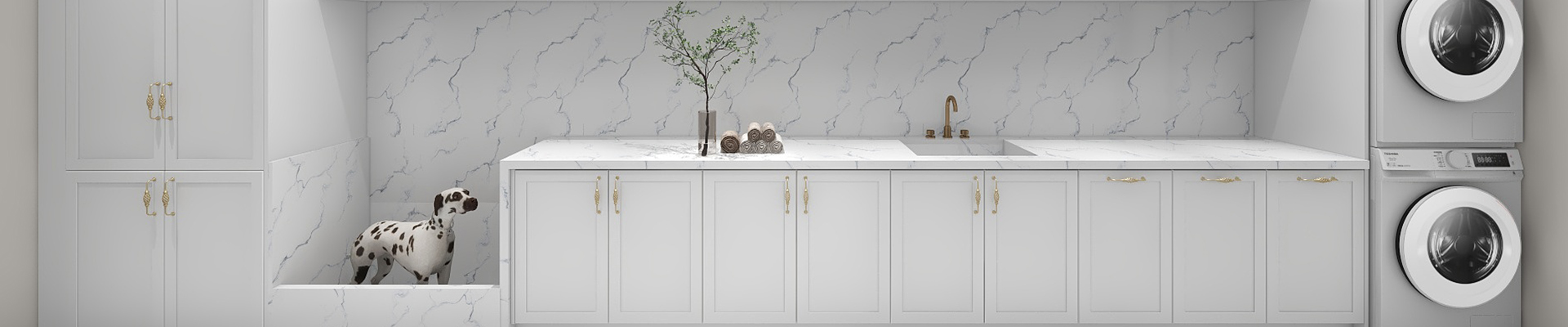



Quartz costs 3–5x laminate installed, but it lasts two to three times as long and does not swell when water reaches a cut edge. For owner-occupied homes, hotels and serviced apartments, quartz is usually the lower cost per year of service. For short-hold rentals where the fit-out will be replaced at handover, laminate is often the rational choice.
Installed cost: laminate $120–220 per linear metre, quartz $350–650.
Service life: laminate 5–8 years, quartz 15+ years with normal use.
Laminate fails at cut edges and sink rims; quartz fails at impact points and direct heat.
Quartz needs no sealing; laminate needs sealed cut-outs in wet areas.
Cost per year of service often favours quartz even when the sticker price does not.
1. What separates the two surfaces
Laminate is a decorative sheet bonded to a particleboard or HMR core. Quartz is an engineered slab of roughly 90–94% crushed stone in a resin binder. The difference is not cosmetic: it changes how the surface behaves at heat, water and impact, and therefore where each one belongs.
2. Installed cost per metre
| Line | Laminate | Quartz |
|---|---|---|
| Material | $40–90/m | $180–380/m |
| Fabrication and cut-outs | $40–70/m | $120–200/m |
| Installation | $40–60/m | $50–70/m |
| Installed total | $120–220/m | $350–650/m |
| Typical life | 5–8 years | 15+ years |
Divide the installed cost by the service life and the gap narrows sharply. Laminate at $170 per metre over six years is about $28 per metre-year; quartz at $500 over fifteen years is about $33. The premium is smaller than the sticker suggests, and it buys fewer replacements and fewer tenant complaints.
3. Heat, water and impact
Quartz resists heat far better than laminate but is not heat-proof: resin can scorch under a hot pan, so trivets still matter. Laminate scorches and lifts at the same temperature. Water is the bigger divider. Quartz is non-porous; laminate swells once water reaches the core, which is why sink rims and cut edges are its weak points. In a laundry or bathroom, that alone usually decides the specification. An HMR core behind the surface is not optional in those rooms, as our carcass materials guide explains.
Impact is where laminate sometimes wins on cost: a chipped laminate sheet can be replaced locally, while a chipped quartz edge needs a resin repair. Both are manageable if the fabricator is local.
4. Edges, sinks and detailing
Quartz allows thin, square edges and undermount sinks with a clean reveal. Laminate needs a substrate edge and usually a post-formed or square-edge profile, and drop-in sinks are safer than undermount. If the design calls for a thin profile or an undermount sink, laminate becomes harder to detail well.
5. Matching the surface to the project
For a rental with an eight-year hold, laminate on an HMR core with sealed cut-outs is defensible and keeps capital in the units. For owner-occupied, hotel and serviced apartments, quartz removes the most common five-year maintenance call, and pairs predictably with the door styles most projects specify. The decision should sit next to the landed cost model, not be made on the benchtop line alone.
6. Specifying without surprises
State the slab range, edge profile, cut-out sealing and who carries the template risk. For laminate, require HMR core in wet areas and sealed edges on site. For quartz, confirm slab thickness and whether the fabricator templates after cabinet installation. The dimensions guide covers the cabinet heights these surfaces sit on, and the 16 mm vs 18 mm comparison explains why core thickness matters under a heavy slab.
7. Warranty, template and who carries the risk
Ask who templates the benchtop and who carries the risk if the cabinet run is out of square. On quartz, the fabricator usually templates after cabinets are installed, which protects the fit but adds a site visit. On laminate, the sheet is often cut from cabinet dimensions, so an out-of-square run shows at the wall. Put the answer in writing before order, and confirm the pre-shipment inspection scope covers benchtop cut-outs, not just cabinets.
Frequently asked questions
Is quartz worth the extra cost over laminate?
On owner-occupied and hotel projects, usually yes: quartz lasts two to three times as long and does not swell at sink cut-outs. On short-hold rentals, laminate replaced once is often cheaper over ten years.
Can laminate be used in a wet area?
Only with sealed cut edges and a moisture-resistant substrate. Standard laminate swells when water reaches the core, which is why laundry and bathroom vanities usually specify quartz or solid surface.
Does quartz need sealing?
No. Quartz is non-porous and does not require annual sealing, unlike natural stone. Avoid direct heat and use a trivet, because resin in the slab can scorch.
How much does a quartz benchtop cost per metre?
Expect $350–650 per linear metre installed, depending on slab range, edge profile and cut-outs. Laminate is typically $120–220 per metre installed.
Can you repair a chipped quartz edge?
Yes, a local repair with colour-matched resin is usually invisible. A chipped laminate edge is harder to repair cleanly and often means replacing the sheet.
Which is better for a rental apartment?
Laminate, if the lease cycle is under eight years and the benchtop can be replaced at handover. Quartz makes more sense where the fit-out is expected to last two lease cycles.