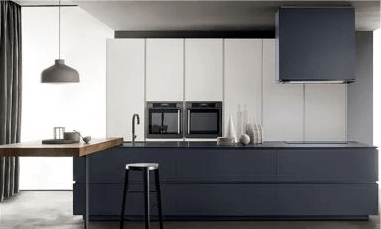
Most Australian apartment and townhouse projects buy cabinets from China on FOB terms and handle clearance and installation locally. The two decisions that move your final cost most areflat-pack versus pre-assembled, and whether your board and emission specification isverified before production starts — not after the container arrives.
Above roughly 20 units, direct-from-factory FOB plus a local installer is usually the lowest total cost — but only if you control the specification.
Ask for five documents before deposit. An emission certificate that names the factory but not your board grade proves very little.
Budget 1.35–1.6× FOB for landed cost once freight, duty, clearance and last-mile delivery are included.
Production runs 30–45 days; sea freight to Australia 18–25 days. Plan 16 weeks from drawing freeze to handover.
Pre-assembled cabinets cost more per unit but usually win on site labour once you pass ~30 units.
1. What Australian buyers actually verify
Australian project buyers are not shopping for a kitchen. They are protecting a handover date, a defect liability period and a margin that was fixed at contract signing. That changes what "good" means in a factory conversation.
In practice, four things get checked before a purchase order is issued:
Board and emission grade. Whether the substrate matches the specified grade, and whether the test report covers the board actually being used — not a generic factory certificate.
Dimensional discipline. Australian projects are drawn to millimetre tolerances around appliance openings and stone bench cut-outs. A cabinet that is 5 mm out at the carcass becomes a 15 mm gap at the bench.
Moisture performance. Coastal projects and laundry areas fail first at the board edge, not the face. Edge-banding quality matters more than the finish name.
Replaceability. If one door is damaged at handover, can a matching door be produced in three weeks? This is where a factory relationship beats a one-off trader.
The most common failure we see is not a bad factory — it is a specification that was never written down precisely enough to be enforceable. A unit-level specification template removes most of that risk before the first deposit.
2. Four sourcing routes compared
There is no single "best" route. The right one depends on unit count, how much specification control you need, and whether you have a local installation team.
| Route | What you control | Typical fit | Main risk |
|---|---|---|---|
| Direct factory, FOB | Full specification, board grade, hardware, packing | 20+ units, repeat projects | You own clearance and site coordination |
| Factory + forwarder, DDP | Product specification only | First order, under 20 units | 8–15% cost premium; less visibility on clearance |
| Australian importer / wholesaler | Little — you buy their range | Small jobs, urgent fills | Specification fixed; margin absorbed by the importer |
| Local manufacturer | Full, plus local support | Heritage, bespoke, tight deadlines | 2–3× unit cost; capacity limits on large runs |
For apartment work, the deciding factor is usually not unit price but who absorbs site risk. On FOB terms you do — which is fine if you have an installer who has handled flat-pack imports before, and expensive if you do not.
3. Five documents to request before deposit
These are the documents that separate a factory from a trading company, and a compliant order from an argument at customs. Request all five, and attach them to the purchase order as annexes.
3.1 Board emission test report
Ask for the test report for the specific board grade you are buying, with the test method stated. Reports are commonly issued against AS/NZS 4266.1 or EN 717-1 chamber methods, and the grade claimed (E1, E0) should match the limit in the report — not just the letter on the brochure.
3.2 Moisture-resistant grade evidence
If the project includes laundry, bathroom or coastal exposure, confirm the board is HMR (moisture resistant) and that the supplier can evidence it. HMR is a board property, not a coating. A green edge is a convention, not a certificate.
3.3 Hardware specification sheet
Brand, model number, and cycle rating for hinges and runners. "Soft close" is not a specification. If the project is rental stock, cycle rating matters more than the brand on the door.
3.4 A shop drawing sample
One typical base unit and one typical wall unit, dimensioned. This is where millimetre discipline is proven or lost, and it costs the factory almost nothing to produce.
3.5 Pre-shipment inspection agreement
State the AQL level, the defect definitions, who inspects, and what happens if the inspection fails. Without this clause, a defect claim after arrival becomes a negotiation rather than a contractual right.
4. Where the money goes per unit
Buyers often compare FOB quotes as if they were the whole cost. They are roughly half of it. The table below shows a typical cost structure for a mid-specification apartment kitchen cabinet package.
| Cost element | Share of FOB | What moves it |
|---|---|---|
| Carcass board and doors | 38–45% | Board grade, door style, panel thickness |
| Hardware | 8–12% | Brand tier, drawer system, lift systems |
| Labour and assembly | 15–20% | Flat-pack vs pre-assembled |
| Finishing | 8–12% | Lacquer coats, veneer, thermofoil |
| Packing | 5–7% | Corner protection, moisture barrier, crating |
| Factory overhead and margin | 12–18% | Order size, payment terms, seasonality |
| Stage | Typical add-on | Note |
|---|---|---|
| FOB | 100 | Baseline |
| Ocean freight | +6–9% | Varies with season and port pair |
| Marine insurance | +0.5% | Usually charged on CIF value |
| Duty | 0–5% | Confirm by HS code; ChAFTA rates often apply |
| Clearance, port and biosecurity | +2–3% | Includes inspection if triggered |
| Last-mile delivery | +3–5% | Metro vs regional differs sharply |
| Landed total | 1.35–1.6× | Plan the upper end for first shipments |
5. Shipping and clearance into Australia
Cabinet packages usually ship from Shenzhen, Guangzhou, Shanghai or Ningbo into Sydney, Melbourne, Brisbane or Fremantle. Transit is typically 18–25 days port to port, plus 3–5 working days for clearance.
Two volume realities matter more than freight rates:
Flat-pack density. A standard apartment kitchen package occupies roughly 0.6–0.9 m³ flat-packed. A 40HQ, loaded to a realistic 65–68 m³, carries about 70–90 packages.
Pre-assembled penalty. Assembled carcasses add 30–40% volume, so the same container carries roughly 45–60 packages. That volume difference is the real cost of pre-assembly — not the labour line on the invoice.
5.1 Biosecurity and packaging
Wood packaging must meet ISPM 15, and Australia applies seasonal biosecurity measures to some origins and cargo types. Check the current DAFF requirements for your sailing window rather than assuming last year's process still applies.
5.2 Documentation that prevents delays
Commercial invoice and packing list with per-carton contents, not just total quantity
Bill of lading consistent with the invoice description
Fumigation or treatment evidence for wood packaging
Any product certificates referenced on the PO, available on request
6. Installation and defect management
A factory can support installation. It cannot perform it. Being clear about that boundary prevents most post-arrival disputes.
| Factory provides | Stays with you / local trade |
|---|---|
| Numbered shop drawings and carton labels | Site measurement verification |
| Installation sequence and hardware schedule | Physical installation labour |
| Spare parts allowance (typically 3–5%) | Electrical and plumbing connections (licensed) |
| Remote video support during install | On-site rectification of building tolerances |
Open and inspect within 7 days of delivery. Photograph the carton label, the damage and the unit in one frame — claims without the carton number are difficult to resolve. Report defects in one consolidated list rather than piecemeal, so the factory can plan a single replacement run.
7. Vetting a factory in 12 checks
Twelve questions, in the order that reveals the most, fastest:
Are you the manufacturer? Ask for video of the panel saw, edge-bander and finishing line running.
What is annual capacity, in cabinets per month?
Which export markets do you ship to most, and do you have Australian project references?
Which board suppliers do you buy from, and can you show the purchase record?
What edge-banding thickness and adhesive do you use as standard?
Which hardware brands, and are they authorised distributors?
How many coats on a lacquer finish, and what is the curing process?
What does your in-process quality check look like — first article, patrol, final?
How are cabinets packed for a 30-day sea voyage?
What is the sampling lead time and cost, and is it credited against the order?
What is the minimum order quantity, in containers?
Who responds if a defect appears after arrival, and within what window?
The answers that should end the conversation: no factory video, no board traceability, and "we can do any specification" without a single clarifying question.
8. A 16-week schedule that holds
| Week | Stage | What must be true to proceed |
|---|---|---|
| 1–2 | Specification and sampling | Unit drawings frozen; board and finish chosen |
| 3 | Sample approval and contract | Sample signed off; documents annexed to PO |
| 4 | Deposit and production slot | Payment cleared; slot confirmed in writing |
| 4–9 | Production (30–45 days) | Weekly photo updates; first-article check at day 7 |
| 9 | Final inspection | AQL inspection passed before packing closes |
| 10 | Container loading and departure | Packing list matches carton count |
| 10–14 | Ocean transit | Documents pre-lodged for clearance |
| 13 | Clearance and delivery booking | Duty paid; delivery slot secured |
| 14–16 | Site delivery and installation | Installer booked; lift and storage arranged |
The schedule fails in one place more than any other: week 1–3. A specification that is still changing at week 4 pushes production into the Chinese New Year window or the pre-summer freight peak, and the handover date absorbs the difference.
Frequently asked questions
Is it actually cheaper to buy cabinets from China for an Australian project?
For mid-specification apartment work above roughly 20 units, yes — typically 30–50% below Australian custom manufacturing on a landed basis. The gap narrows sharply on small orders, on very high-end finishes, and when site rectification costs are added because the specification was loose.
Which compliance documents should I request before paying a deposit?
Five: the board emission test report for your specific grade, evidence of moisture-resistant board if specified, the hardware specification sheet, a dimensioned shop drawing sample, and a pre-shipment inspection agreement with AQL and defect definitions. Attach all five to the purchase order.
How long does shipping from China to Australia take?
Port to port, 18–25 days depending on the port pair and season, plus 3–5 working days for clearance. Add 5–10 days for last-mile delivery and site booking. Production itself is 30–45 days.
Can a Chinese factory produce to Australian dimensions?
Yes — production is driven by your drawings, not by a fixed catalogue. What needs confirming at sampling is the module logic: carcass thickness, scribe allowances, and how appliance openings are dimensioned. Get one base and one wall unit dimensioned before approving the run.
What is the minimum order quantity?
Most cabinet factories quote from one 20GP container, which is roughly 25–30 apartment kitchen packages flat-packed. Below that, the per-unit freight and setup cost usually erases the price advantage.
Who handles installation in Australia?
The factory supplies numbered drawings, carton labelling, an installation sequence and remote support. Physical installation is done by your local team. Electrical and plumbing connections must be carried out by licensed trades under state requirements.