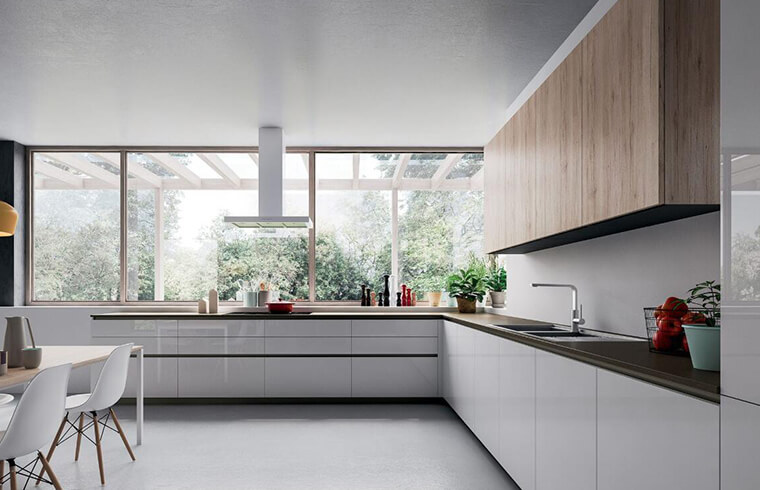
When planning a kitchen, cabinet material is often chosen based on appearance or upfront cost. However, from a professional cabinet industry perspective, material selection affects far more than visual style. It directly influences durability, maintenance effort, long-term cost, and overall project value.
Therefore, understanding the real differences between laminate kitchen cabinets, hardwood veneer kitchen cabinets, and solid wood kitchen cabinets is essential before making a decision. Each material has its own structure, performance limits, and suitable use scenarios.
With that in mind, this article takes a practical approach. Instead of focusing on trends or personal taste, it explains how these cabinet materials differ in construction, performance, and long-term behavior, helping homeowners and project buyers make informed, realistic choices.
Before comparing performance, it is important to clearly define what each cabinet material actually is. Many misunderstandings come from marketing terms rather than technical structure.
Laminate kitchen cabinets are made by bonding a synthetic decorative layer onto a core material, usually MDF or particle board. The laminate surface itself is produced by pressing resin-treated paper layers under heat and pressure.
As a result, laminate cabinets offer a uniform appearance with consistent color and pattern. They are widely used in residential projects, rental properties, and commercial spaces due to their cost efficiency and ease of maintenance.
From a functional standpoint, laminate kitchen cabinets are non-porous, making them resistant to stains and easy to clean. However, because the surface is bonded rather than integral, long-term durability depends heavily on edge sealing, adhesive quality, and installation conditions.
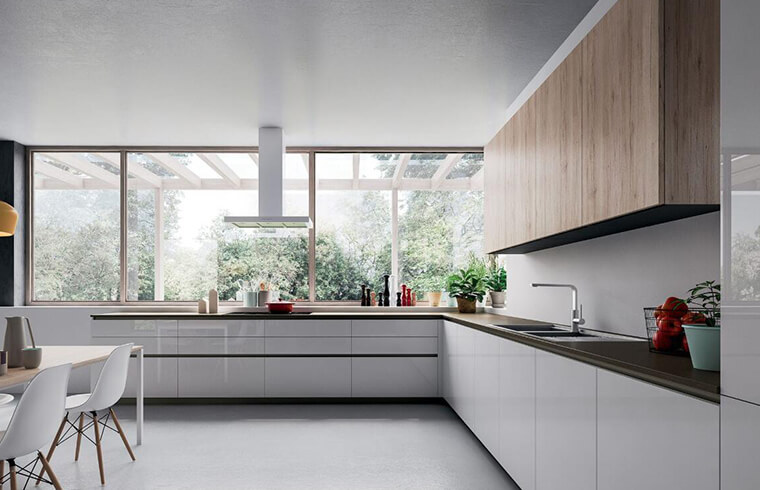
Hardwood veneer kitchen cabinets use a thin layer of real wood applied over a stable core, typically plywood or MDF. The veneer thickness is limited, but the surface is genuine wood, showing natural grain patterns and color variation.
Compared with laminate kitchen cabinets, hardwood veneer cabinets provide a more authentic wood appearance. This makes them a common choice for mid-range residential kitchens where a natural look is desired without the cost of solid wood.
At the same time, veneer cabinets rely on the stability of their core material. While they are generally more stable than solid wood in changing humidity, their thin surface limits how often they can be sanded or refinished.
Solid wood kitchen cabinets use natural hardwood for visible surfaces such as doors, drawer fronts, and face frames. Common wood species include oak, maple, cherry, and ash.
Unlike laminate or veneer, solid wood cabinets have depth and structural integrity throughout the material. This allows for repeated refinishing and long-term use. For this reason, solid wood kitchen cabinets are often associated with high-end residential projects and custom kitchens.
It is important to note that in industry practice, “solid wood cabinets” usually refers to solid wood components rather than an entirely solid wood cabinet box. This construction approach balances strength, stability, and cost control.
While surface appearance is visible, internal structure determines how cabinets perform over time. This is where real differences begin to appear.
Laminate kitchen cabinets typically use MDF or particle board cores. These materials are dimensionally stable in dry environments but can be sensitive to prolonged moisture exposure if sealing fails.
Hardwood veneer kitchen cabinets often use plywood cores, which offer better moisture resistance and screw-holding strength. This improves cabinet rigidity and long-term stability.
Solid wood kitchen cabinets rely on proper wood selection, drying, and joinery. Solid wood expands and contracts with humidity, so experienced manufacturing and installation are critical to prevent warping or cracking.
From a durability perspective, laminate kitchen cabinets perform well in controlled environments but can peel, chip, or swell if exposed to heat or moisture over time.
Hardwood veneer kitchen cabinets generally last longer than laminate, provided the veneer remains intact and the core is high quality. However, deep scratches or edge damage can be difficult to repair invisibly.
Solid wood kitchen cabinets offer the longest service life. Because the material is solid throughout, surface wear can be repaired, sanded, and refinished multiple times, extending usability for decades.
Beyond durability, cabinet material affects design freedom and visual character.
Laminate kitchen cabinets provide a clean, uniform look. Modern laminates can replicate wood grain, stone, or solid colors with high consistency, which is useful for contemporary designs.
Hardwood veneer kitchen cabinets offer natural variation in grain and tone. This creates warmth and depth that laminate cannot fully replicate. Each cabinet front has subtle differences, which many homeowners consider a benefit.
Solid wood kitchen cabinets deliver the strongest visual depth. The thickness, grain continuity, and natural aging process contribute to a richer appearance over time.
Laminate cabinets are limited to factory-produced colors and textures. Once manufactured, modification options are minimal.
Hardwood veneer cabinets can be stained or painted within limits, although refinishing is restricted by veneer thickness.
Solid wood kitchen cabinets offer the highest customization potential. They can be stained, painted, or refinished multiple times, making them suitable for long-term design changes.
Laminate kitchen cabinets require minimal maintenance. Their sealed surface allows easy cleaning with standard household products.
Hardwood veneer kitchen cabinets need more care, especially to protect edges and surfaces from moisture. Gentle cleaning and controlled humidity help extend their lifespan.
Solid wood kitchen cabinets require routine care similar to fine furniture. Proper sealing and occasional refinishing help maintain performance and appearance.
Laminate cabinets are difficult to repair once damaged. In many cases, replacement is the only solution.
Hardwood veneer cabinets allow limited surface repair but cannot tolerate aggressive sanding.
Solid wood kitchen cabinets are the most repair-friendly. Scratches, dents, and wear can be addressed through sanding and refinishing, which reduces long-term replacement costs despite higher initial investment.
Below is a practical comparison to summarize the key differences:
Feature | Laminate Kitchen Cabinets | Hardwood Veneer Kitchen Cabinets | Solid Wood Kitchen Cabinets |
Surface Material | Synthetic laminate | Real wood veneer | Solid hardwood |
Core Structure | MDF / Particle board | MDF or plywood | Mixed wood construction |
Appearance | Uniform, consistent | Natural wood grain | Deep, natural texture |
Durability | Moderate | Medium to high | High |
Repairability | Limited | Limited | Excellent |
Refinishing | Not possible | Limited | Multiple times |
Maintenance | Low | Medium | Medium |
Typical Lifespan | Short to medium | Medium | Long-term |
Cost Level | Low | Mid-range | Higher upfront |
For family homes where kitchens are used daily for cooking, storage, and social interaction, durability and maintenance are critical considerations. In such environments, cabinet doors and drawer fronts experience frequent contact, moisture exposure, and occasional impact.
Laminate kitchen cabinets can work for families seeking low maintenance and easy cleaning, especially in secondary homes or budget-controlled renovations. However, once edges peel or surfaces chip, repairs are limited.
Hardwood veneer kitchen cabinets offer a balance for family homes that want a natural wood look with moderate durability. With proper care and controlled humidity, veneer cabinets perform well in medium-use kitchens.
Solid wood kitchen cabinets are often the most suitable choice for primary family homes where long-term use is expected. Their ability to be refinished allows homeowners to refresh the kitchen over time rather than replace it entirely, reducing lifetime cost despite higher initial investment.
For rental kitchens and investment properties, decision-making typically prioritizes cost control, durability, and ease of replacement. Visual appeal is important, but long-term repair flexibility is less critical than predictable performance.
In this context, laminate kitchen cabinets are widely used due to their low upfront cost and uniform appearance. They are easy to clean between tenants and quick to install, which suits fast project timelines.
Hardwood veneer kitchen cabinets may be selected for higher-end rentals where a natural look adds value, but owners must accept that repair options are limited if damage occurs.
Solid wood kitchen cabinets are less common in rental projects unless the property targets the luxury market. While durable, the higher upfront cost is usually harder to justify in standard rental scenarios.
For custom homes or owner-occupied projects with a long planning horizon, cabinet material becomes a long-term investment decision rather than a short-term cost choice.
Hardwood veneer kitchen cabinets are frequently chosen for custom kitchens that emphasize design, warmth, and consistency. They provide real wood aesthetics while maintaining better dimensional stability than solid wood in certain climates.
Solid wood kitchen cabinets remain the preferred option for homeowners who value craftsmanship, customization, and longevity. Because solid wood can be refinished multiple times, it supports design changes over the life of the home without full cabinet replacement.
In these projects, laminate kitchen cabinets are less common unless used strategically in secondary areas such as utility rooms or pantries.
Beyond project type, cabinet material selection must align with budget structure and installation schedules.
Laminate kitchen cabinets typically offer the shortest production and installation timeline, making them suitable for projects with tight deadlines.
Hardwood veneer kitchen cabinets require more careful manufacturing and finishing, resulting in moderate lead times.
Solid wood kitchen cabinets involve the most labor-intensive production process. While lead times are longer, the extended service life often offsets the initial delay in long-term planning.
From a lifecycle cost perspective, laminate cabinets may appear economical upfront but often require earlier replacement. Solid wood cabinets, while more expensive initially, frequently deliver better value over decades of use.
From the standpoint of a professional kitchen cabinet supplier, material selection should never be isolated from usage conditions and project constraints. In real projects, material-related issues often arise not because the material is “bad,” but because it was chosen without considering how the kitchen will actually be used.
Experienced suppliers typically evaluate:
Kitchen layout and workflow
Daily usage frequency
Moisture and heat exposure
Budget flexibility
Expected service life
For example, recommending laminate kitchen cabinets for a high-moisture cooking environment without proper edge protection increases failure risk. Likewise, supplying solid wood kitchen cabinets for a short-term rental may misalign cost with project goals.
A reliable kitchen cabinet supplier helps clients avoid these mismatches by aligning material choice with functional requirements, not just appearance.
There is no universally “best” option among laminate, hardwood veneer, and solid wood kitchen cabinets. Each material performs well when used in the right context.
Laminate kitchen cabinets suit cost-sensitive and time-driven projects.
Hardwood veneer kitchen cabinets balance natural appearance with controlled cost.
Solid wood kitchen cabinets deliver long-term durability, repairability, and value.
Ultimately, the right decision comes from understanding how the kitchen will be used, how long it is expected to last, and what level of maintenance is acceptable.
If you are planning a kitchen project and want material recommendations based on real-world performance—not guesswork—working with an experienced kitchen cabinet supplier makes a measurable difference.
BFP supports residential and project clients with:
Practical material guidance
Stable manufacturing standards
Project-based cabinet solutions
Reliable delivery timelines
By combining industry experience with application-focused advice, BFP helps ensure your cabinet investment fits your project—not just today, but for years to come.


We employ cookies to analyze website traffic and enhance your browsing experience. Data securely aggregated, privacy protected. See Privacy Policy for details.