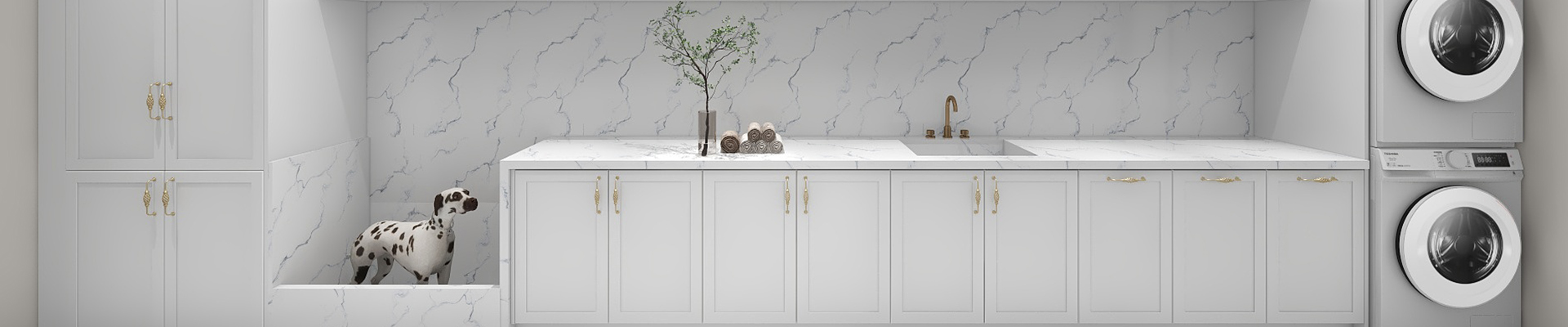



Pré-assemblé if your programme is tight, your site labour is expensive or unavailable, or you need the box to arrive square. RTA if freight and storage dominate your cost and you control the assembly crew. The tipping point is usually around 30 units on a long sea route — below that, the freight saving rarely covers the site labour.
Flat-packing puts 40–60% more cabinetry in the same container. That is a volume saving, not a 40–60% cost saving — freight is one line of the landed cost.
RTA is only as square as the person who assembles it. If the installer is not your team, the quality standard is not yours either.
Cam-and-dowel and confirmat joints can be dismantled later. A glued factory carcasse cannot — that matters for alterations and for re-use.
Site assembly runs at roughly 25–40 carcasses per two-person crew per day, before doors and adjustment.
On projects under about 30 units, pre-assembled usually wins once you count the snagging time RTA creates.
1. What actually changes
It is not the cabinet. Board, hardware, finition and door profile can be identical. What changes is who builds the box, when, and how much air you pay to ship.
The joint is the technical fork. RTA boxes use cam-and-dowel or confirmat so they can be assembled with a drill and a screwdriver. Pre-assembled boxes are usually glued and clamped in the factory, which is stronger and permanently square — and impossible to take apart.
| Propriétés | RTA | Pré-assemblé |
|---|---|---|
| Volume d'expédition | Le plus bas | 30 à 60 % plus élevé |
| Site labour | Assemblage complet | Position and fix |
| Commun | Cam-and-dowel or confirmat | Glued dowel, clamped |
| Équerrage | As good as the assembler | Set in the factory |
| modification ultérieure | Can be dismantled | Parfaitement fixé |
2. The freight maths, honestly
A 40 ft high-cube holds roughly 55–65 m³. Flat-packed cabinetry uses that volume at maybe 85% efficiency; assembled boxes waste 30–50% of it in the voids around them. That is where the 40–60% figure comes from.
But freight is not the whole landed cost. A typical import sits at roughly 1.35–1.6× FOB once freight, duty, clearance and delivery are counted, and the freight share of that varies enormously with route. On a short route with cheap containers, the saving can be swallowed by site labour. On a long route, it is the difference between winning and losing the job.
| Produit | Emballé à plat | Pré-assemblé |
|---|---|---|
| 40 ft high-cube volume | ≈65 m³ | ≈65 m³ |
| Usable volume after packing | ≈55 m³ | ≈38–45 m³ |
| Unités par conteneur | Baseline | 30 à 50 % de moins |
| Coût du fret par unité | Coût en adjuvantation plus élevé. | Meilleure performance du béton |
| Storage before install | Compact | Needs floor area |
3. Site labour and the programme
A two-person crew will build 25–40 carcasses a day, and that is before doors, tiroirs, adjustment and cleaning. On a 200-unit apartment job, that is five to eight working days of pure assembly — plus the defects that only appear after assembly.
Pre-assembled units turn that into positioning: unpack, set, fix, level. The labour does not disappear, it moves to a factory where it is cheaper and repeatable, and it leaves the site programme for trades that cannot be moved off site.
If the programme has float, RTA is fine. If the handover date is fixed and the trades are stacked, it is a risk you are taking on behalf of the client.
4. Who squares the box
This is the argument that decides most projects, and it is rarely written down. A glued carcass leaves the factory square because it was clamped square. An RTA carcass is square if the assembler checked the diagonal — and most do not, because the drawing does not ask them to.
The failure shows up months later as a door gap at one corner, a drawer that binds, or a run that will not close against a wall. It is fixable, but only by someone with authority on site, and by then the unit is full of somebody else’s kitchen.
| Analyse | RTA | Pré-assemblé |
|---|---|---|
| Box square on arrival | Non | Oui |
| Qualité d'assemblage | Site crew dependent | Contrôle d'usine |
| Dommages causés par le transport | Dommage sur les bords | Dommages aux coins et à la face |
| Snagging after install | Meilleure performance du béton | Coût en adjuvantation plus élevé. |
| Coût de reprise | Site labour rates | Factory, before shipping |
5. How to specify either one
For RTA, specify packing, not just product: panels numbered to a part list, fittings bagged by cabinet rather than by type, and a carton label carrying unit reference, room and elevation. A mixed bag of cams across forty cabinets costs more in labour than the freight saved.
For pre-assembled, specify the assembly state explicitly — carcass glued and squared, fronts separate, fittings bagged per unit — and inspect the diagonal before packing. Three units per pallet, not one per shipment.
Foire aux questions
Is RTA cheaper than pre-assembled?
Usually 8–15% cheaper at the same specification, before freight. Once freight is added the gap widens on long routes and narrows on short ones.
How much container space does flat-packing save?
Roughly 40–60% more units per container, depending on unit sizes and how well the cartons are packed.
Can pre-assembled cabinets be adjusted on site?
They can be positioned and levelled, but the box cannot be re-squared once the glue has cured. Any twist has to be caught before packing.
Which is better for a remote site?
Pre-assembled, unless you are sending your own assembly crew. RTA assumes skilled labour that remote sites often do not have.
Do RTA cabinets look different once installed?
No. The visible cabinet is identical. The difference is inside the joint and behind the back panel.