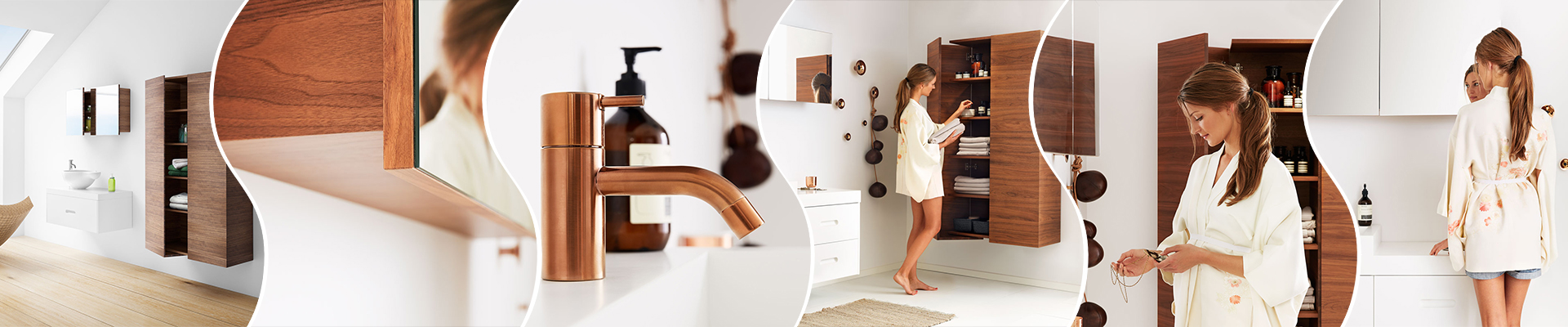
Particleboard is the economical default, MDF is smoother for painting, and plywood is stronger and more moisture tolerant. The choice is driven by the finish, the wet area and the budget, not by a single best board. In wet areas, HMR particleboard or plywood; for painted doors, MDF; for heavy use, plywood.
Particleboard is the economical default.
MDF is smoother for paint but heavier.
Plywood is stronger at the edge and more moisture tolerant.
18 mm is the standard; 16 mm suits some wall units.
Wet areas need HMR or plywood, not standard board.
1. The three boards
Particleboard is made from wood chips bonded with resin. MDF is made from fine fibres, which gives a dense, smooth surface. Plywood is made from layers of veneer, which gives strength and moisture tolerance. Each behaves differently at the edge, under water and under a screw.
2. Comparaison
| Propriétés | Panneaux de particules | MDF | Contreplaqué |
|---|---|---|---|
| Prix | Le plus bas | Moyenne | Le plus élevé |
| Vis de maintien | Bon | Bon | Mieux |
| Humidité | Poor unless HMR | Médiocre | Bon |
| Surface | Grossier | Lisse | UN DÉLICE |
| Poids | Moyenne | Lourde | Moyenne |
The table is a starting point. The finishing system often decides the board, because paint needs a smooth surface and veneer needs a stable core.
3. Strength and screw holding
Plywood holds screws best because the layers resist pull-out. Particleboard is adequate for most hinges and runners but can crumble if a screw is overtightened. MDF holds well but is heavy, which stresses hinges on wide doors.
4. Humidité
Standard particleboard and MDF swell when water reaches the core. HMR particleboard slows it; plywood tolerates it better. In a bathroom or laundry, the board choice and the edge sealing matter more than the brand. The HMR guide covers the wet-area requirement.
5. Finition
MDF is the best substrate for paint because it is smooth and uniform. Veneer can go on MDF or plywood; plywood gives a better edge but can telegraph grain through a thin veneer. Melamine faces are usually applied to particleboard or MDF. The door finishes guide covers the surface options.
6. Coût
Particleboard is the cheapest, MDF is in the middle, plywood is the most expensive. The gap is smaller than the finished cabinet price suggests, because the board is one line of many. Do not choose the cheapest board and then spend the saving on repairs.
7. Choosing a board
Start with the finish: paint needs MDF, veneer needs a stable core, melamine suits particleboard. Then check the wet areas: HMR or plywood. Then check the weight and the hinges. The plywood vs MDF comparison covers the trade-off in detail.
8. Specifying and checking
Name the board, the thickness, the grade and the edge treatment. Check the core and the invoice at inspection. A board that looks right but has no invoice is a claim, not a specification.
9. Une liste de vérification avant de s'engager
Avant de signer, veuillez confirmer six points : la qualité du circuit imprimé, le modèle de matériel, le système de finition, les normes d’emballage, le périmètre d’inspection et les modalités de paiement. Chaque point doit être confirmé par écrit, et non par téléphone. La liste de vérification du devis permet de synthétiser ces six éléments en un tableau comparatif d’une seule page.
10. Erreurs courantes
L'erreur la plus fréquente consiste à comparer le prix d'usine avec le coût final. La deuxième est d'omettre l'inspection du budget. La troisième est de payer le solde avant la validation de l'inspection. Chacune de ces erreurs est évitable grâce à un cahier des charges écrit et une inspection avant expédition.
11. Comment mesurer la pièce
Mesurez chaque mur en trois points : en haut, au milieu et en bas, et retenez la plus petite mesure. Les murs sont rarement d'équerre, et une courbure de 10 mm sur trois mètres modifie le remplissage. Mesurez le plafond à chaque angle et repérez les prises électriques, les radiateurs et les canalisations d'évacuation avant de dessiner. Un relevé précis est plus rapide qu'un dessin, et le guide de mesure est fourni avec une fiche imprimable.
13. A specification checklist
Write four lines for every material: the product, the grade, the thickness and the surface or edge treatment. A material specified by name alone leaves the grade to the factory, and the grade is where the cost and the performance sit.
14. Questions the factory will ask
Expect four questions: which grade, which thickness, which edge and which batch. The answers should already be in the specification. If they are not, the factory will choose, and the choice will be the cheapest that meets the drawing.
Foire aux questions
Which carcass board is best?
None universally. Particleboard is the economical default, MDF is smoother for painting, plywood is stronger and more moisture tolerant. Match the board to the finish and the room.
Is plywood worth the extra cost?
In wet areas and heavy-use kitchens, often yes: it holds screws better and tolerates moisture. In dry bedrooms, the premium is harder to justify.
Why is MDF used for painted doors?
MDF has a dense, uniform surface that paints smoothly and does not show grain. It is heavy and needs good hinges.
Does 16 mm or 18 mm matter?
18 mm is the standard for strength and screw holding. 16 mm saves weight and cost in wall units but is weaker for wide drawers and heavy tops.
Can particleboard be used in a bathroom?
Only HMR particleboard with sealed edges, and even then it is the minimum. Plywood or compact laminate is better in a wet room.
How do I check the board?
Look at the core, the edge and the invoice. A board invoice naming the grade is stronger evidence than a colour.